

Visa rules and fees on this page were verified in February 2026. Immigration rules change frequently — check GOV.UK for the latest.
The short answer
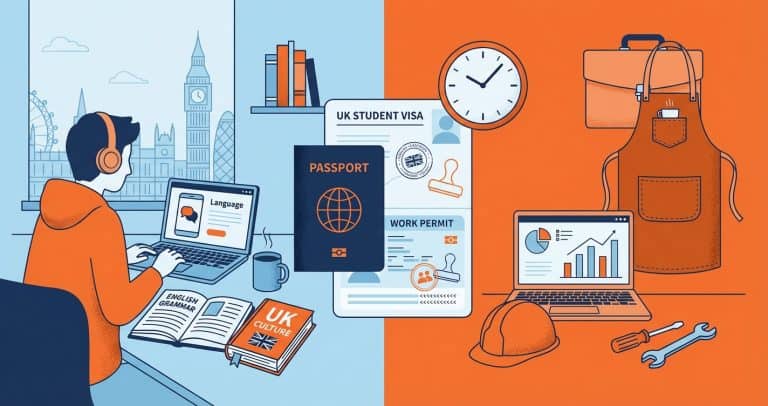
Most international students studying English at a UK language school cannot work. The visa types used for English language courses — the Standard Visitor visa and the Short-term Study Visa — do not allow any paid or unpaid work.
There are exceptions, and they depend entirely on your visa type and nationality. This guide covers the main routes and explains what each one allows.
Visa types and work rights
| Visa type | Can you study English? | Can you work? | Maximum stay | Visa fee |
|---|---|---|---|---|
| Standard Visitor | Yes, up to 6 months | No (paid or unpaid) | 6 months | £127 (or visa-exempt) |
| Short-term Study Visa | Yes, 6–11 months | No (paid or unpaid) | 11 months | £214 |
| Student visa (English at B2+) | Yes | 10 hrs/week in term, full-time in holidays | Course length | £524 |
| Youth Mobility Scheme | Yes | Full-time | 2–3 years | £319 |
Why most English language students cannot work
The reason comes down to which visa you hold. The two most common routes for language students are:
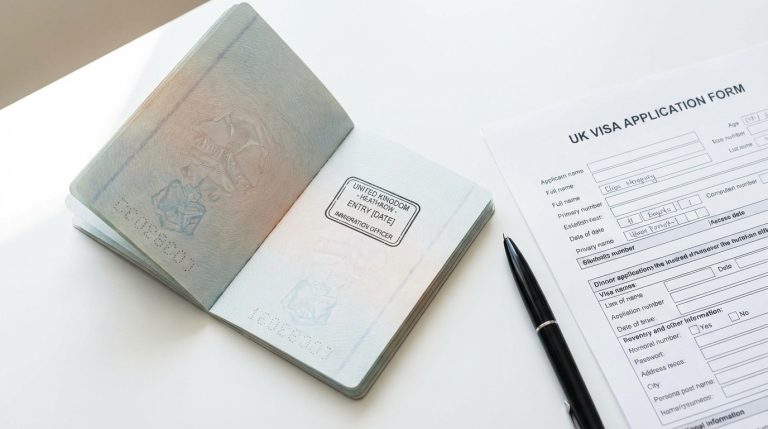
Standard Visitor visa (courses up to 6 months) — This is the most common route. Citizens of many countries (including EU/EEA, US, Canada, Australia, and Japan) can enter the UK without applying for a visa at all and study for up to 6 months. Others need a Standard Visitor visa costing £127. Either way, the rules are the same: no paid or unpaid work, no work experience, no work placements.
Short-term Study Visa (courses 6–11 months) — For longer English courses, visa-national students need an STSV at £214. The work restriction is identical: no paid or unpaid work of any kind.
These are the routes used by the vast majority of students at UK language schools, and both prohibit work entirely.
The Student visa route
The Student visa does allow limited work, but it comes with conditions that most English language students cannot meet.
To hold a Student visa for an English course, the course must be:
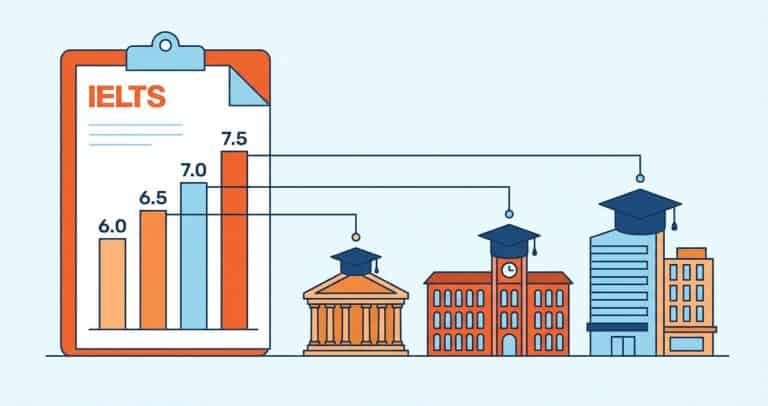
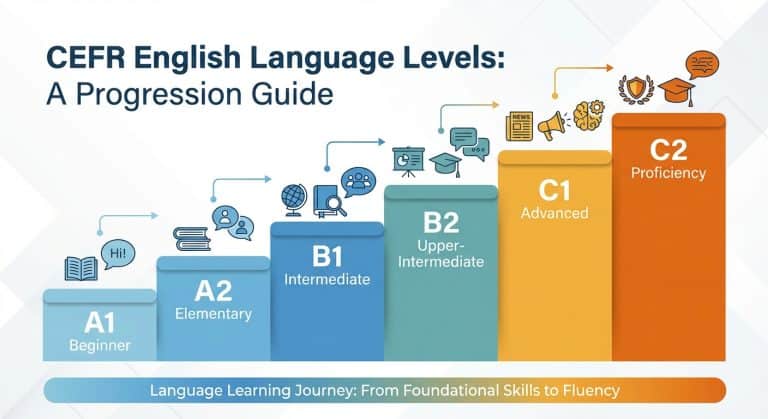
- At B2 level or above on the CEFR scale
- At a school that holds a Student visa sponsor licence from the Home Office
Most standalone English language schools are not Student visa sponsors. This licence is primarily held by universities and further education colleges offering degree-level programmes.
Even if your school does hold the licence, English language courses are classified as below degree level. That means your work hours are capped at 10 hours per week during term time (full-time during holidays). This is half the 20-hour allowance that degree-level students receive.
You also cannot be self-employed, run a business, or work as a professional sportsperson. The Student visa costs £524, plus the Immigration Health Surcharge of £776 per year.
The Youth Mobility Scheme
The Youth Mobility Scheme (YMS) is the main route that lets you work full-time while studying English in the UK. You can take on any job (with a few exceptions) and study at the same time — there is no restriction on combining the two.
The catch is eligibility. The YMS is only open to citizens of specific countries, aged 18 to 30 (or 35 for some nationalities):
| Country | Age limit | Notes |
|---|---|---|
| Australia, Canada, New Zealand, South Korea | 18–35 | Can extend to 3 years total (AU/CA/NZ) |
| Japan, Monaco, Iceland | 18–30 | 2-year visa |
| Andorra, San Marino, Uruguay | 18–30 | 2-year visa |
| Hong Kong, Taiwan | 18–30 | Ballot system, limited places |
| India | 18–30 | Separate Young Professionals Scheme, 3,000 places/year |
The YMS visa costs £319, plus the Immigration Health Surcharge (£776 per year). You need to show at least £2,530 in savings. If you are from an eligible country and within the age range, this is by far the most flexible option for combining work and study.
Budgeting without work income
If you cannot work — which applies to most language students — you need to fund your stay entirely from savings, family support, or scholarships. Here are some practical ways to keep costs manageable:
- Choose a homestay — Living with a host family through a service like London Homestays includes meals and bills, which removes the unpredictability of budgeting for food, utilities, and internet separately
- Study outside London — Weekly living costs are noticeably lower in cities like Bristol, Birmingham, and Ipswich compared to London. Our cost of living guide breaks down typical expenses by city
- Pick the right course intensity — A shorter, more intensive course (25–30 hours per week) can achieve the same progress in fewer weeks than a standard course (15–20 hours per week), reducing your total living costs
- Cook at home — If you are in self-catering accommodation, buying groceries and cooking rather than eating out will save you a lot over a multi-week stay
Use the Course Finder to compare options across cities and course types. You can filter by price, location, and intensity to find a programme that fits your budget.
Frequently asked questions
Can I do volunteer work on a visitor or Short-term Study Visa?
No. The restriction covers unpaid work as well as paid work. Volunteering, work experience, and internships are all prohibited on these visa types.
Can I work part-time if my English school is a Student visa sponsor?
Yes, but only up to 10 hours per week during term time (and full-time during holidays). You need a Student visa, which costs £524, and the school must sponsor your application. Very few standalone language schools hold this licence.
What jobs can Student visa holders do?
Most jobs are allowed, but you cannot be self-employed, fill a permanent full-time vacancy, or work as a professional sportsperson or entertainer. The 10-hour term-time limit means you are restricted to part-time roles.
Does the Youth Mobility Scheme guarantee a place?
For most eligible countries, yes — there is no quota and you can apply at any time. However, citizens of Hong Kong, Taiwan, and India enter a ballot system with limited places each year.
Can I extend my Short-term Study Visa to get work rights?
No. The Short-term Study Visa cannot be extended, and you cannot switch to a different visa type from within the UK. If you want a visa that allows work, you would need to apply from your home country.
What if I already have the right to live and work in the UK?
If you hold settled status, indefinite leave to remain, a spousal visa, or another immigration status that includes work rights, you can work without restriction while studying English. These rights come from your existing visa, not from your course.