

What is the CEFR?
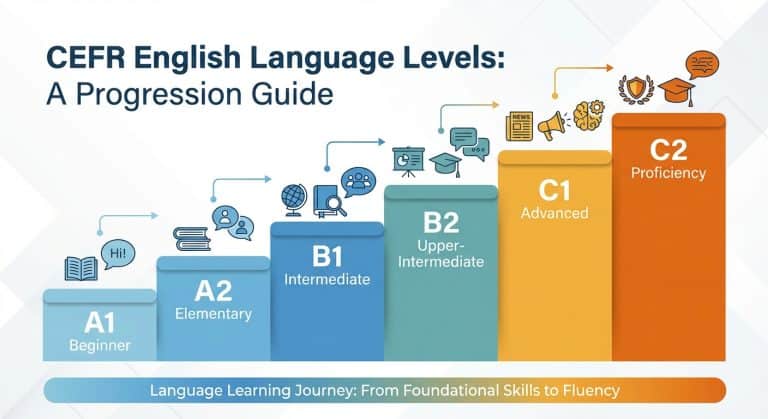
The Common European Framework of Reference for Languages (CEFR) is the international standard for describing language ability. It divides learners into six levels, from A1 (beginner) to C2 (mastery), and is used by schools, universities, employers, and immigration authorities worldwide.
When you apply for an English course in the UK, your school will assess your level — usually with a placement test on day one — and put you in a class that matches. Knowing your CEFR level before you start helps you choose the right course type, estimate how long you need to study, and set realistic goals.
Not sure of your level? Take our free 40-question English level test to find out in about 30 minutes.
The six CEFR levels explained
A1 — Beginner
At A1, you can understand and use basic everyday expressions. You can introduce yourself, ask and answer simple questions about personal details (where you live, people you know, things you have), and interact in a simple way if the other person speaks slowly and clearly.
Typical study hours to reach: 0 to 100 hours
Suitable courses: General English (Beginner), summer courses for complete beginners
A2 — Elementary
At A2, you can handle routine tasks and communicate in simple, everyday situations. You can describe your background, immediate environment, and matters of immediate need. You can understand sentences about familiar topics like shopping, local geography, and employment.
Typical study hours to reach: 100 to 200 hours
Suitable courses: General English (Elementary)
B1 — Intermediate
B1 is the level where you start to become an independent user. You can deal with most situations likely to arise while travelling, describe experiences and events, give reasons and explanations for opinions and plans, and produce simple connected text on familiar topics.
This is the minimum level that many employers look for, and it is the entry point for some professional English courses.
Typical study hours to reach: 350 to 400 hours
Suitable courses: General English (Intermediate), Business English, some IELTS Preparation courses
B2 — Upper Intermediate
B2 is a critical threshold. At this level, you can understand the main ideas of complex text on both concrete and abstract topics, interact with a degree of fluency and spontaneity that makes regular interaction with native speakers quite possible, and produce clear, detailed text on a wide range of subjects.
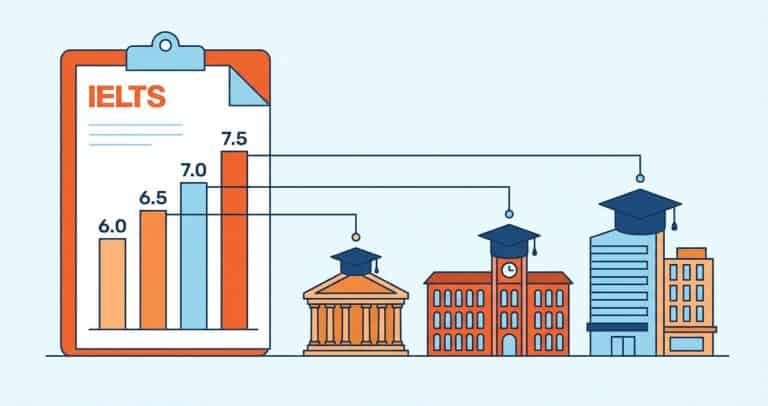
Most UK universities require B2 (IELTS 5.5 to 6.5) for undergraduate admission. Many professional roles also require B2 as a minimum.
Typical study hours to reach: 500 to 600 hours
Suitable courses: General English (Upper Intermediate), IELTS Preparation, Cambridge B2 First (FCE), Academic English
C1 — Advanced
At C1, you can understand a wide range of demanding, longer texts and recognise implicit meaning. You can express yourself fluently and spontaneously without much obvious searching for expressions. You can use language flexibly and effectively for social, academic, and professional purposes.
C1 (IELTS 7.0 to 7.5) is required for many postgraduate programmes and competitive professional roles. It is also the level needed for some visa categories.
Typical study hours to reach: 700 to 800 hours
Suitable courses: General English (Advanced), IELTS Preparation, Cambridge C1 Advanced (CAE), Academic English
C2 — Proficiency (Mastery)
C2 is the highest level. You can understand with ease virtually everything heard or read. You can summarise information from different spoken and written sources, reconstructing arguments and accounts in a coherent presentation. You can express yourself spontaneously, very fluently, and precisely, differentiating finer shades of meaning even in the most complex situations.
C2 (IELTS 8.5 to 9.0) is rarely required for university or work, but it is the target for language professionals, translators, and those who want near-native command.
Typical study hours to reach: 1,000 to 1,200 hours
Suitable courses: Cambridge C2 Proficiency (CPE), advanced exam preparation
All six levels at a glance
| Level | Name | What You Can Do | Study Hours | IELTS Equivalent |
|---|---|---|---|---|
| A1 | Beginner | Basic greetings, simple questions | 0–100 | — |
| A2 | Elementary | Routine tasks, familiar topics | 100–200 | 3.0–3.5 |
| B1 | Intermediate | Travel situations, opinions, connected text | 350–400 | 4.0–5.0 |
| B2 | Upper Intermediate | Complex discussion, clear writing, university entry | 500–600 | 5.5–6.5 |
| C1 | Advanced | Fluent expression, demanding texts, professional use | 700–800 | 7.0–7.5 |
| C2 | Proficiency | Near-native precision, any context | 1,000–1,200 | 8.5–9.0 |
Study hours are cumulative from zero and assume guided classroom instruction. Self-study, immersion, and individual aptitude all affect the actual time needed.
Which level do you need?
The level you should aim for depends on your goal:
University study in the UK — Most undergraduate programmes require B2 (IELTS 5.5 to 6.5). Competitive courses at top universities may ask for C1 (IELTS 7.0+). Postgraduate programmes typically require B2 to C1 depending on the field. Consider an Academic English or IELTS Preparation course to reach your target.
Working in the UK — B1 is the minimum for most customer-facing and administrative roles. B2 is expected for professional and managerial positions. Regulated professions (medicine, law, engineering) often require C1 or higher. A Business English course can help you reach the level your industry requires.
Daily life and travel — A2 is enough for basic interactions: shopping, ordering food, asking directions. B1 makes independent living comfortable. If you plan to live in the UK long-term, aim for B1 or above.
UK visa requirements — Some visa categories require a Secure English Language Test (SELT) at a specified level. For example, the Partner Visa requires A1 for the initial application and A2 for the extension. Check the visa requirements for your specific category.
Find your level
If you are not sure where you stand, our free English level test gives you a CEFR result in about 30 minutes. The test covers grammar, vocabulary, and reading comprehension across 40 questions, with questions that adapt to your ability.
Once you know your level, use the Course Finder to search for courses that match. You can filter by level, course type, city, and price to find exactly what you need.
Frequently asked questions
How long does it take to go up one CEFR level?
It varies, but a common estimate is 150 to 200 guided learning hours per level from B1 upwards. Moving from A1 to A2 is faster (roughly 100 hours). Moving from C1 to C2 is slower and requires extensive reading and exposure beyond the classroom. An intensive course (25 to 30 hours per week) can cover one level in about 6 to 8 weeks.
What is the difference between CEFR and IELTS?
CEFR is a general framework that describes language ability on a six-level scale (A1 to C2). IELTS is a specific test that gives a score from 1.0 to 9.0. The two are mapped to each other: for example, IELTS 6.0 corresponds roughly to B2. CEFR levels are used for course placement, while IELTS scores are required for university applications and visa purposes.
Can I study at any level?
Yes. UK language schools accept students from complete beginner (A1) to advanced (C1/C2). You take a placement test on your first day and are placed in a class that matches your current level. You do not need any previous qualifications or certificates.
Which English exam should I take?
It depends on your purpose. For UK university applications, IELTS Academic is the most widely accepted. For professional qualifications, check what your industry body requires. For general proof of level, Cambridge exams (B2 First, C1 Advanced, C2 Proficiency) are well-recognised globally and do not expire, unlike IELTS which is valid for 2 years.
Is B2 enough for university?
For most UK undergraduate programmes, yes. B2 (typically IELTS 5.5 to 6.5) meets the entry requirements for the majority of courses. However, some competitive programmes, particularly at Russell Group universities or in fields like law and medicine, require C1 (IELTS 7.0+). Always check the specific requirements of the course and university you are applying to.
How accurate are online level tests?
A well-designed online test can give a reliable indication of your reading, grammar, and vocabulary level. However, it cannot assess speaking or writing in the same way as a face-to-face exam. Our level test uses adaptive questioning to give an accurate CEFR placement, which schools use alongside their own assessment on the first day of your course.